Publication Process
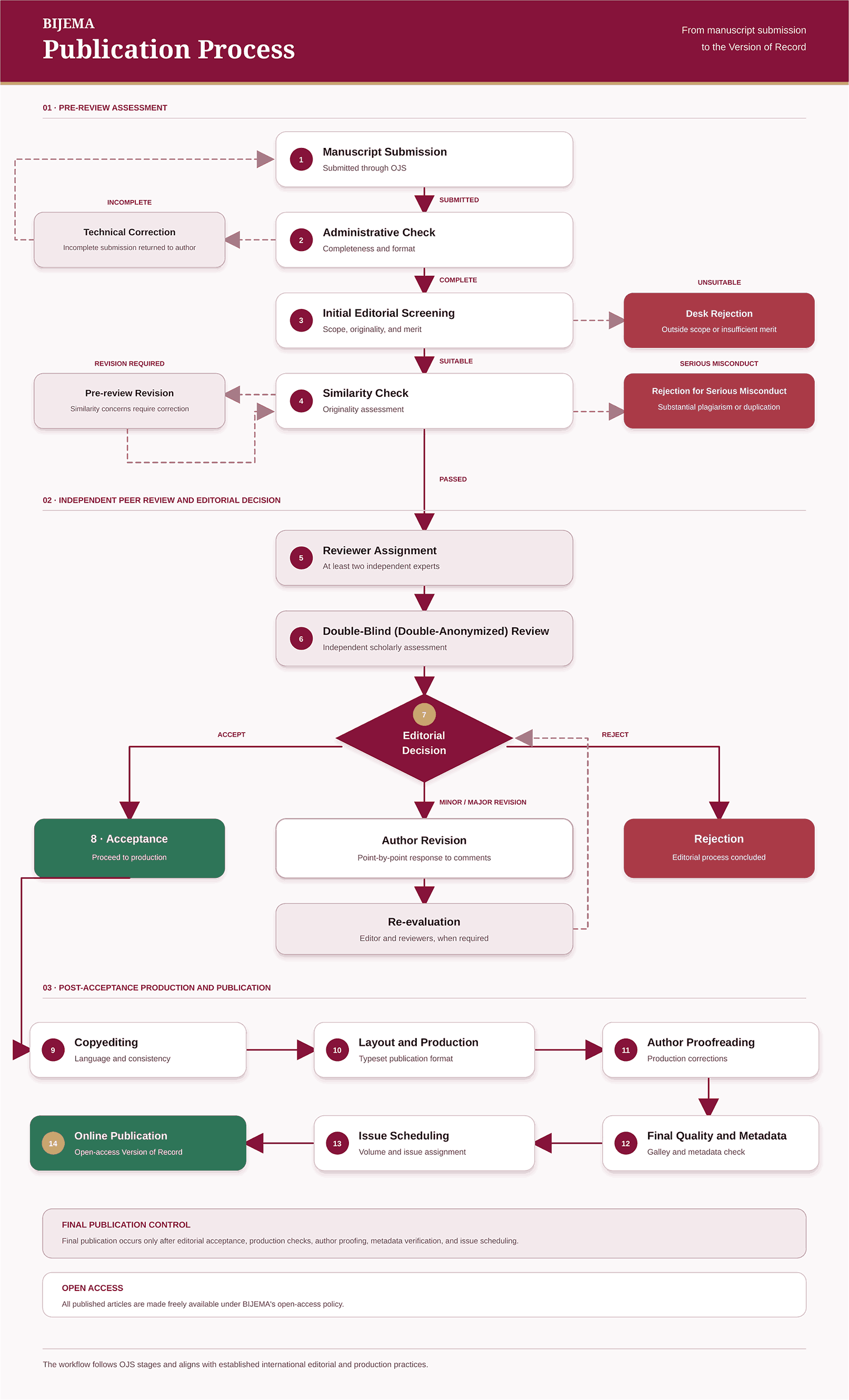
The BIJEMA Publication Process describes the complete workflow through which a manuscript progresses from its initial submission to the publication of the official Version of Record. The process consists of three main phases: Pre-Review Assessment, Independent Peer Review and Editorial Decision, and Post-Acceptance Production and Publication. A manuscript can only proceed to production after it has successfully completed the editorial and peer-review stages and received formal acceptance.
1. Pre-Review Assessment
1.1 Manuscript Submission
The publication process begins when an author submits a manuscript through BIJEMA’s Open Journal Systems (OJS). The submitted manuscript is registered in the journal’s editorial system and enters the pre-review assessment stage. Submission through OJS does not mean that the manuscript has been accepted for review or publication. Every submitted manuscript must first undergo an Administrative Check, Initial Editorial Screening, and Similarity Check.
1.2 Administrative Check
The editorial team examines the submission to determine whether it is complete and follows the required format. If the submission is complete and appropriately formatted, it proceeds to the Initial Editorial Screening. If the submission is incomplete or does not follow the required format, it is returned to the author for Technical Correction. The author must complete or correct the submission before submitting it again through OJS. The corrected submission then returns to the Manuscript Submission stage and undergoes another administrative assessment. Technical Correction is part of the administrative process and does not represent an academic acceptance or rejection decision.
1.3 Initial Editorial Screening
After passing the Administrative Check, the manuscript undergoes an Initial Editorial Screening. During this stage, the editor assesses the manuscript’s scope, originality, and academic merit. The editor determines whether the manuscript is relevant to the journal and sufficiently suitable to continue through the publication process. If the manuscript is considered suitable, it proceeds to the Similarity Check. If the manuscript is outside the journal’s scope or has insufficient academic merit, it receives a Desk Rejection. A manuscript that receives a desk rejection does not proceed to external peer review.
1.4 Similarity Check
A suitable manuscript undergoes a Similarity Check as part of the journal’s originality assessment. This stage is completed before the manuscript is assigned to independent reviewers. If the manuscript passes the originality assessment, it proceeds to Reviewer Assignment. If correctable similarity concerns are identified, the manuscript is returned to the author for Pre-review Revision. After the author has addressed the identified concerns, the revised manuscript returns to the Similarity Check stage for another originality assessment. If substantial plagiarism, substantial duplication, or serious publication misconduct is identified, the manuscript receives a Rejection for Serious Misconduct and does not proceed to peer review.
2. Independent Peer Review and Editorial Decision
2.1 Reviewer Assignment
A manuscript that passes the pre-review assessment is assigned to at least two independent experts. The reviewers independently assess the manuscript and submit their scholarly evaluations to the editor. The manuscript only enters this stage after successfully completing the administrative check, initial editorial screening, and similarity check.
2.2 Double-Blind Review
The manuscript undergoes a double-blind (double-anonymized) review. The identities of the authors are not disclosed to the reviewers, and the identities of the reviewers are not disclosed to the authors. The reviewers conduct an independent scholarly assessment and submit their review reports to the editor. These reports inform the editorial decision but do not replace the editor’s responsibility for determining the final outcome.
2.3 Editorial Decision
After considering the manuscript and the reviewers’ reports, the editor issues an Editorial Decision. The possible decisions are acceptance, minor or major revision, or rejection. If the manuscript is considered academically suitable for publication, it receives an acceptance decision. If further improvement is required, the manuscript is returned to the author for Minor or Major Revision. The author must submit a revised manuscript together with a point-by-point response to the reviewers’ comments. The revised manuscript then undergoes Re-evaluation by the editor and, when required, by the reviewers. Following re-evaluation, the manuscript returns to the Editorial Decision stage. The editor may subsequently accept the manuscript, request further revision, or reject it. If the manuscript does not meet the journal’s publication requirements, it receives a Rejection decision, and the editorial process is concluded.
2.4 Acceptance
A manuscript that successfully completes the editorial and peer-review process receives formal Acceptance. Acceptance confirms that the manuscript may proceed to production. An accepted manuscript is not immediately published online. It must first complete the post-acceptance production and publication stages.
3. Post-Acceptance Production and Publication
3.1 Copyediting
After acceptance, the manuscript enters the Copyediting stage. During this stage, the accepted manuscript is prepared for publication by reviewing its language and consistency. Copyediting ensures that the presentation of the manuscript is consistent before it is converted into the journal’s publication format. Completion of copyediting allows the manuscript to proceed to Layout and Production.
3.2 Layout and Production
Following copyediting, the manuscript enters the Layout and Production stage. The manuscript is typeset and prepared according to the journal’s publication format. The output of this stage is a publication galley that presents the article in its intended final layout. The prepared galley is then sent to the author for proofreading.
3.3 Author Proofreading
The author reviews the production version of the manuscript during the Author Proofreading stage. At this stage, the author identifies production corrections that need to be made before publication. After the necessary production corrections have been communicated and addressed, the article proceeds to the Final Quality and Metadata stage.
3.4 Final Quality and Metadata
The editorial team conducts a final check of the article galley and its publication metadata. This stage ensures that the final publication file and the corresponding article information are ready for publication. The article can proceed to scheduling only after the galley and metadata have completed this final check.
3.5 Issue Scheduling
After the final quality and metadata check, the article enters the Issue Scheduling stage. The accepted and production-ready article is assigned to an appropriate volume and issue in accordance with the journal’s publication schedule. Issue assignment takes place before the article is released as the official Version of Record.
3.6 Online Publication
After completing issue scheduling, the article is published online as the official Version of Record. The Version of Record is the final published version of the article made available by BIJEMA. All published articles are freely available under BIJEMA’s open-access policy. Final publication occurs only after editorial acceptance, production checks, author proofing, metadata verification, and issue scheduling. The workflow follows OJS stages and aligns with established international editorial and production practices.