Peer Review Process
Dioikisi: Journal of Accounting and Management Review (DJAMR) applies a double-blind peer-review process to maintain the academic quality, objectivity, and integrity of every article considered for publication. Under this system, the identities of the authors are not disclosed to the reviewers, and the identities of the reviewers are not disclosed to the authors. The peer-review process begins only after a manuscript has passed the administrative check, editorial screening, similarity screening, and research-ethics assessment. Editorial decisions are based on the manuscript’s scholarly merit, relevance to the journal’s focus and scope, methodological soundness, originality, clarity, and contribution to accounting and management scholarship.
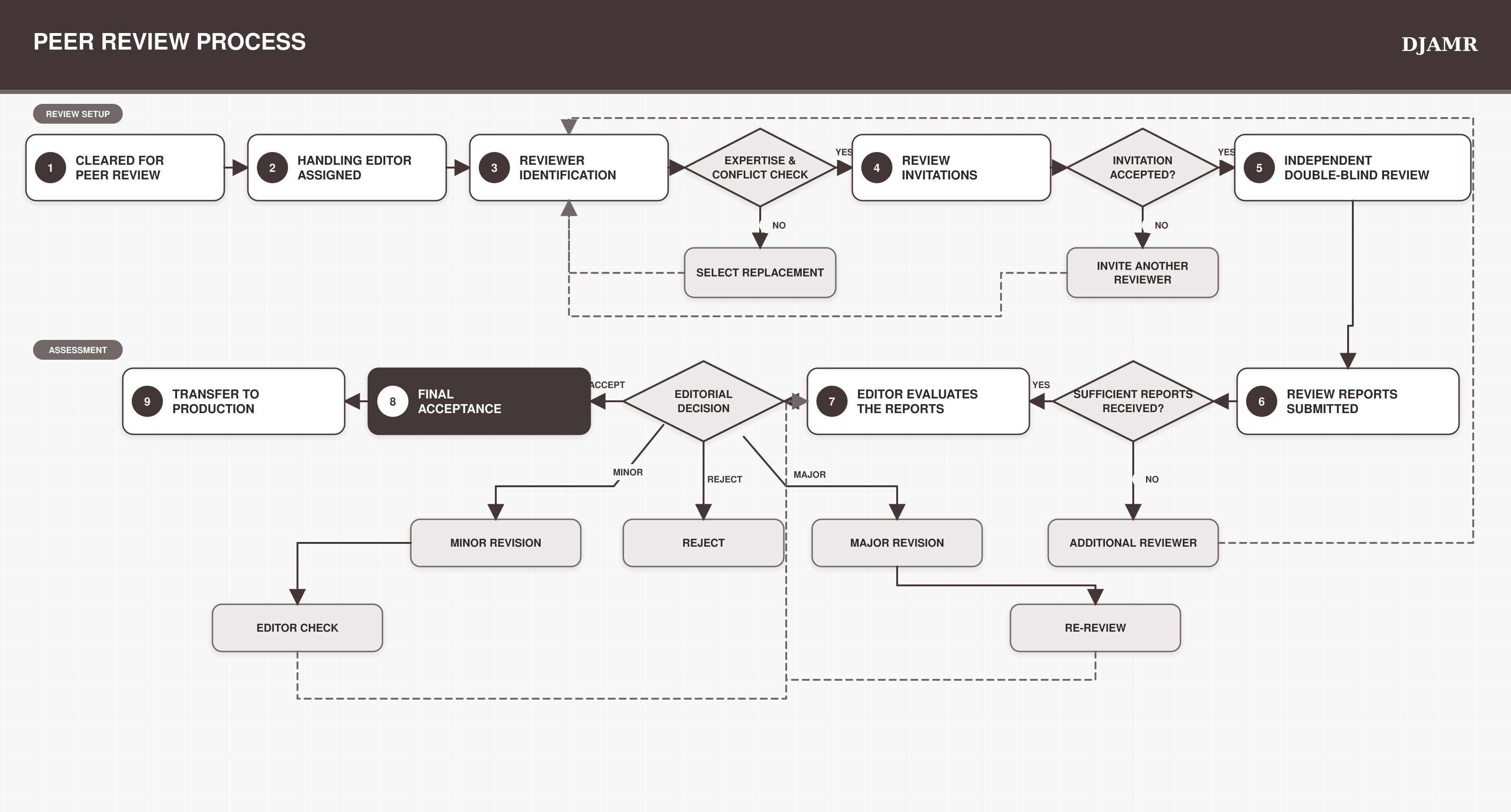
1. Cleared for Peer Review
A manuscript enters the peer-review process after it has successfully passed the journal’s preliminary screening stages. At this point, the editorial office has confirmed that the manuscript is sufficiently complete, relevant to the focus and scope of DJAMR, prepared according to the journal’s requirements, and eligible to proceed to scholarly evaluation. Clearance for peer review does not indicate that the manuscript has been accepted for publication. It only confirms that the manuscript has met the minimum requirements for independent academic assessment.
2. Handling Editor Assigned
The Editor-in-Chief assigns the manuscript to a handling editor whose academic background or editorial responsibilities are relevant to the subject of the manuscript. Before accepting the assignment, the handling editor must consider whether any personal, professional, financial, institutional, or academic conflict of interest could affect the impartial management of the manuscript. The handling editor coordinates the review process, selects appropriate reviewers, evaluates the review reports, communicates editorial requirements to the author, and prepares an editorial recommendation. The handling editor is responsible for ensuring that the manuscript is processed fairly, confidentially, and consistently with the journal’s editorial policies.
3. Reviewer Identification
The handling editor identifies potential reviewers with appropriate expertise in the manuscript’s subject area, theoretical framework, research method, or disciplinary context. Reviewer selection is based on scholarly competence and the reviewer’s ability to provide an independent and constructive assessment. When identifying reviewers, the editor considers their field of expertise, research experience, publication record, previous reviewing performance, and availability. The editor should avoid appointing individuals whose institutional, collaborative, competitive, personal, or financial relationships with the authors could compromise—or reasonably appear to compromise—the objectivity of the review.
Expertise and Conflict Check
Before an invitation is issued, each potential reviewer is examined for relevant expertise and possible conflicts of interest. If the proposed reviewer possesses suitable expertise and no conflict of interest is identified, the process continues to the reviewer invitation stage. If the reviewer’s expertise is not sufficiently relevant or a potential conflict of interest exists, the reviewer is not appointed.
Select Replacement
When a proposed reviewer does not satisfy the expertise or conflict-of-interest requirements, the handling editor selects a replacement. The process then returns to the Reviewer Identification stage so that another qualified and independent reviewer can be considered. This selection cycle may be repeated until an appropriate reviewer is identified.
4. Review Invitations
Qualified reviewers are formally invited to evaluate the manuscript. The invitation provides sufficient information for the invited reviewer to determine whether the manuscript falls within their area of expertise and whether they can complete the review objectively and within the required period. Before accepting the invitation, reviewers must consider their competence, availability, confidentiality obligations, and any potential conflict of interest. Reviewers who believe that they cannot provide a fair, independent, or timely assessment should decline the invitation promptly.
Invitation Accepted?
If the reviewer accepts the invitation and confirms their suitability, the manuscript proceeds to the independent double-blind review stage.
Invite Another Reviewer
If the invitation is declined, remains unanswered, or cannot be accepted within the journal’s editorial requirements, the handling editor invites another reviewer. The process returns to Reviewer Identification to ensure that the replacement reviewer has suitable expertise and no conflict of interest. The manuscript will not proceed to substantive review until appropriate reviewers have accepted the assignment.
5. Independent Double-Blind Review
The manuscript is evaluated independently under the double-blind review system. Reviewers assess the manuscript without being informed of the authors’ identities, affiliations, or other identifying information. Authors are likewise not informed of the reviewers’ identities. Reviewers evaluate the manuscript according to its originality, academic significance, relevance to the journal’s scope, clarity of research objectives, adequacy of the literature review, appropriateness of the theoretical framework, soundness of the research design, validity of the analysis, reliability of the findings, quality of the discussion, and accuracy of the conclusions. Reviewers should also examine whether the manuscript provides proper acknowledgment of relevant sources, presents tables and figures accurately, reports ethical approval or informed consent where applicable, and avoids unsupported claims, plagiarism, redundant publication, data manipulation, or other forms of research misconduct. The review must be objective, respectful, evidence-based, and constructive. Personal criticism of the authors is inappropriate. Reviewers must treat the manuscript as a confidential document and must not share, reproduce, discuss, or use its unpublished content for personal or professional advantage.
6. Review Reports Submitted
After completing the evaluation, reviewers submit their reports to the journal. A review report should clearly explain the manuscript’s strengths, weaknesses, required improvements, and the reasoning supporting the reviewer’s recommendation. Comments intended for the authors should be constructive and sufficiently detailed to guide revision. Reviewers may also provide confidential comments to the editor when necessary, particularly concerning suspected ethical violations, undisclosed conflicts of interest, substantial similarity with another publication, unreliable data, or other matters requiring editorial attention. Reviewer recommendations support the editorial process but do not determine the final decision. Responsibility for the editorial decision remains with the journal’s editor.
Sufficient Reports Received?
The handling editor examines whether sufficient independent assessments have been received to support a fair and informed editorial decision. The editor considers not only the number of reports received but also their completeness, relevance, clarity, and academic quality. If the available reports provide an adequate basis for evaluating the manuscript, the process continues to the editorial assessment stage.
Additional Reviewer
If the reports are incomplete, substantially conflicting, outside the necessary area of expertise, or otherwise insufficient to support an editorial decision, the manuscript is referred to an additional reviewer. The process then returns to Reviewer Identification, where another qualified and independent reviewer is selected, checked for expertise and conflicts of interest, and invited to review the manuscript.
7. Editor Evaluates the Reports
The handling editor evaluates all review reports together with the manuscript. The editor considers the substance and quality of the reviewers’ comments rather than making a decision solely by counting reviewer recommendations. The editor examines whether the reviewers have identified major theoretical, methodological, analytical, ethical, or reporting issues. The editor also considers whether the recommendations are consistent with the evidence presented in the reports and whether the requested revisions are relevant to improving the manuscript. Based on this assessment, the editor may issue one of four decisions: accept, minor revision, major revision, or reject.
Minor Revision
A minor revision decision is issued when the manuscript is generally sound but requires limited corrections or clarification. These revisions may involve improving the presentation of arguments, clarifying particular methods or findings, correcting inconsistencies, adding relevant references, revising tables or figures, or addressing minor language and formatting issues. The author must submit a revised manuscript together with a clear response explaining how each editorial and reviewer comment has been addressed. Changes made in the manuscript should be identifiable, and comments that have not been followed should be accompanied by a reasoned academic explanation.
Editor Check
The revised manuscript is checked by the handling editor to determine whether the required minor corrections have been completed satisfactorily. A further external review is not automatically required for a minor revision unless the editor considers it necessary. After the editor check, the manuscript returns to Editor Evaluates the Reports. The editor may accept the manuscript, request additional revision, or reject it if the responses remain inadequate.
Major Revision
A major revision decision is issued when the manuscript has potential for publication but requires substantial improvement. Major revisions may concern the theoretical foundation, research design, methodology, analysis, interpretation of results, structure of the discussion, presentation of evidence, ethical reporting, or alignment between the research objectives and conclusions. A major revision is not a guarantee of acceptance. The author must carefully address every reviewer and editor comment, revise the manuscript comprehensively, and submit a detailed response letter showing where and how the requested changes have been made.
Re-review
A manuscript submitted after major revision is normally returned for further academic assessment. The revised manuscript and the author’s response are examined to determine whether the major concerns have been resolved adequately. After re-review, the manuscript returns to Editor Evaluates the Reports. The editor may accept the manuscript, request another revision, or reject it. More than one revision cycle may occur when additional clarification or correction is necessary.
Reject
A rejection decision may be issued when the manuscript contains fundamental weaknesses that cannot reasonably be corrected through revision, does not make a sufficient scholarly contribution, falls outside the journal’s scope, presents unreliable or unsupported findings, fails to satisfy research-ethics requirements, or does not adequately address the reviewers’ and editor’s concerns. The rejection decision concludes the peer-review process for that submission. The editorial decision and relevant reviewer comments are communicated to the corresponding author.
8. Final Acceptance
A manuscript receives final acceptance only after the editor is satisfied that all substantive academic, methodological, ethical, and reporting requirements have been fulfilled. The journal issues a formal acceptance decision to the corresponding author. Once accepted, the manuscript is considered ready to leave the peer-review stage. Substantive changes to the research content, authorship, data, analysis, or conclusions should not be made after acceptance unless specifically requested or approved by the editor.
9. Transfer to Production
The accepted manuscript and its supporting files are transferred to the production process. Editorial correspondence, final manuscript files, tables, figures, supplementary materials, and relevant publication information are checked before production begins. At this point, the manuscript proceeds to copyediting, typesetting, author proofreading, final editorial checking, DOI and metadata preparation, and online publication.