Publication Process
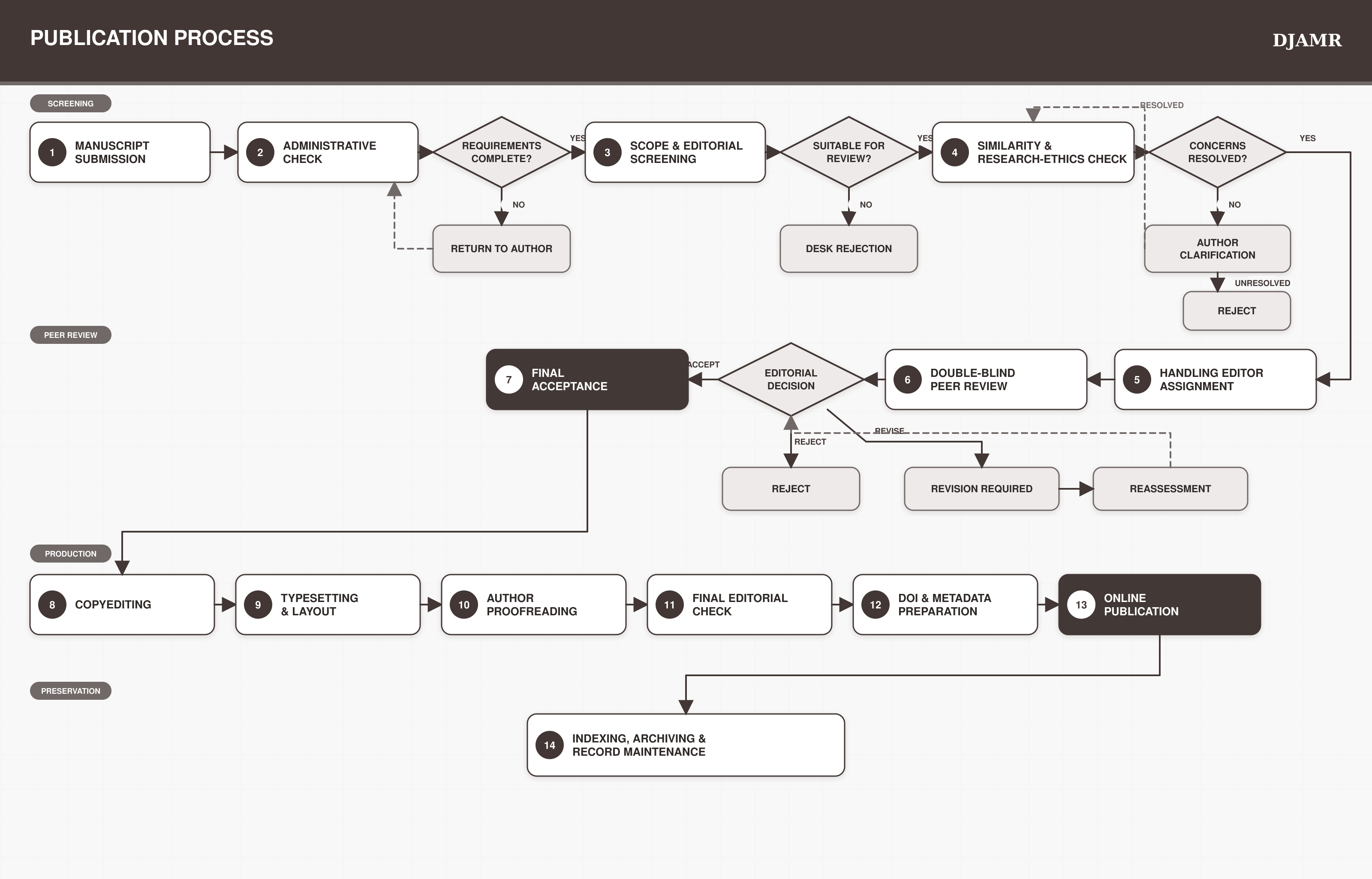
The publication process of Dioikisi: Journal of Accounting and Management Review (DJAMR) covers every stage from manuscript submission to online publication and long-term record maintenance. Each manuscript is processed through administrative verification, editorial assessment, similarity and research-ethics screening, double-blind peer review, production, publication, and preservation. The sequence described below corresponds directly to the DJAMR Publication Process diagram.
1. Manuscript Submission
Authors submit their manuscripts through the journal’s online submission system. The corresponding author is responsible for ensuring that the submitted manuscript represents the work approved by all listed authors and that all required information and supporting files have been provided. By submitting a manuscript, the authors confirm that the work is original, has not been published previously, is not simultaneously under consideration by another journal, and complies with the journal’s publication ethics, copyright, licensing, and authorship policies. The submission is recorded in the journal system and assigned a manuscript identification number for editorial tracking and communication.
2. Administrative Check
The editorial office conducts an administrative examination before the manuscript receives academic evaluation. This examination determines whether the submission files are complete and whether the manuscript complies with the journal’s basic technical and submission requirements. The check may cover the completeness of manuscript files, author and affiliation information, corresponding-author details, title and abstract, keywords, references, tables, figures, declarations, supporting documents, and the preparation of an anonymized manuscript for double-blind peer review. The editorial office may also check whether the manuscript follows the journal template, language requirements, citation style, file format, and general author guidelines.
Requirements Complete?
If all administrative requirements have been fulfilled, the manuscript proceeds to Scope and Editorial Screening.
Return to Author
If files, declarations, identifying information, formatting elements, or other required materials are incomplete, the manuscript is returned to the corresponding author. This return is an administrative action and does not constitute an academic rejection. The author must complete or correct the submission according to the editorial instructions. After resubmission, the manuscript returns to the Administrative Check stage and is examined again before it can proceed.
3. Scope and Editorial Screening
After passing the administrative check, the manuscript is screened by the editor. The purpose of this stage is to determine whether the submission is suitable for consideration by DJAMR before external reviewers are invited. The editor considers the manuscript’s relevance to accounting or management, consistency with the journal’s focus and scope, academic significance, originality, clarity of objectives, general methodological adequacy, quality of presentation, and potential contribution to scholarly knowledge or professional practice. The editor may also consider whether the manuscript is sufficiently developed for external evaluation and whether its subject matter is appropriate for the journal’s readership.
Suitable for Review?
If the manuscript is relevant, adequately prepared, and potentially contributes to the journal’s field, it proceeds to Similarity and Research-Ethics Check.
Desk Rejection
A manuscript may be rejected without external review when it falls outside the journal’s focus and scope, lacks sufficient academic quality or originality, does not present a clear scholarly contribution, contains fundamental methodological problems, or is not prepared to a standard that allows meaningful peer review. The corresponding author is notified of the desk-rejection decision. The manuscript does not proceed to reviewer assignment.
4. Similarity and Research-Ethics Check
A manuscript that passes editorial screening is examined for text similarity and potential research-ethics concerns. Similarity-screening software may be used to identify overlap with published or publicly available material. However, a similarity score is treated as an indicator requiring editorial interpretation and is not used as the sole basis for determining plagiarism. The editorial team examines the nature, extent, and location of the identified similarities. Properly quoted material, references, standard terminology, and legitimate methodological descriptions are distinguished from unattributed copying, inappropriate paraphrasing, self-plagiarism, duplicate publication, or excessive reuse of previously published material. The manuscript may also be examined for concerns involving authorship, conflicts of interest, data integrity, ethical approval, informed consent, participant confidentiality, use of copyrighted material, undisclosed prior publication, and other matters relevant to responsible research and publication.
Concerns Resolved?
If no material concern is identified, or if the available documentation establishes that the manuscript complies with the journal’s requirements, the manuscript proceeds to Handling Editor Assignment.
Author Clarification
If the editorial team identifies a similarity or research-ethics concern that requires explanation, the manuscript is referred to the corresponding author for clarification. The author may be requested to revise overlapping text, provide appropriate citations, submit ethical approval or consent information, explain the use of data or previously published material, confirm authorship contributions, disclose a conflict of interest, or provide other supporting documentation.
Resolved
If the author provides an adequate explanation or correction, the manuscript returns to the Similarity and Research-Ethics Check stage. The editorial office verifies the revised manuscript and supporting information before allowing the manuscript to proceed.
Unresolved
If the author does not provide an adequate response, fails to correct the identified problem, or if the examination confirms serious plagiarism, duplicate publication, data manipulation, unethical research, or another material violation, the manuscript is rejected.
5. Handling Editor Assignment
A manuscript that passes the screening stages is assigned to a handling editor with relevant subject knowledge. The handling editor oversees the academic evaluation of the manuscript and manages communication throughout the peer-review process. The handling editor identifies qualified reviewers, verifies reviewer expertise and independence, monitors the submission of review reports, evaluates revisions, and prepares the editorial decision. An editor who has a conflict of interest with the manuscript must not manage its review.
6. Double-Blind Peer Review
The manuscript undergoes independent evaluation under the journal’s double-blind peer-review system. The authors’ identities are concealed from reviewers, and reviewer identities are concealed from the authors. Reviewers examine the manuscript’s originality, theoretical contribution, methodological soundness, quality of analysis, validity of findings, strength of discussion, ethical compliance, clarity of presentation, and relevance to accounting and management research. Reviewers provide comments and recommendations to assist the editor in making an informed decision and to help the authors improve the manuscript. Reviewer recommendations are advisory; the final authority for the decision rests with the editor.
Editorial Decision
After considering the manuscript and the review reports, the editor issues one of three principal decisions: accept, revision required, or reject.
Accept
The manuscript proceeds to Final Acceptance when the editor determines that it satisfies the journal’s academic, methodological, ethical, and reporting standards and that no further substantive revision is required.
Revision Required
A revision decision is issued when the manuscript has publication potential but requires changes before a final decision can be made. The author must revise the manuscript and provide a point-by-point response explaining how the editor’s and reviewers’ comments have been addressed. The revised submission must identify the changes made and provide a reasoned explanation for any recommendation that has not been followed.
Reassessment
The revised manuscript is reassessed to determine whether the requested corrections have been completed satisfactorily. Depending on the nature of the revision, reassessment may be conducted by the editor or may involve further reviewer evaluation. After reassessment, the manuscript returns to the Editorial Decision stage. The editor may accept the manuscript, request further revision, or reject it. This cycle may be repeated when additional revision is necessary.
Reject
The manuscript is rejected if it contains fundamental academic, methodological, ethical, or reporting problems; does not provide a sufficient contribution; cannot be improved adequately through revision; or fails to address the reviewers’ and editor’s concerns. The decision and relevant reasons are communicated to the corresponding author, and the publication process for that submission ends.
7. Final Acceptance
Final acceptance is issued after the manuscript has successfully completed peer review and all required revisions have been approved. The editor confirms that the manuscript is academically suitable for publication and authorizes its transfer to production. A formal acceptance notification is sent to the corresponding author. The accepted manuscript becomes the authoritative version for production. Substantive changes to the research content, data, analysis, conclusions, or authorship are not normally permitted after acceptance without explicit editorial approval.
8. Copyediting
The accepted manuscript undergoes copyediting to improve accuracy, consistency, readability, and compliance with the journal’s editorial style. Copyediting may include corrections to grammar, spelling, punctuation, capitalization, terminology, headings, citations, references, tables, figures, and internal consistency. The copyeditor may also identify unclear statements, missing information, inconsistent numerical values, or discrepancies between citations and the reference list. Copyediting must not alter the authors’ findings, arguments, or intended scholarly meaning. Any issue requiring author confirmation is raised as an editorial query.
9. Typesetting and Layout
After copyediting, the manuscript is typeset according to the journal’s publication format. The text, headings, author information, abstract, keywords, tables, figures, references, acknowledgments, and declarations are arranged in the official DJAMR layout. During this stage, the production team ensures that the article is visually consistent, readable, and technically suitable for publication. Page arrangement, typography, spacing, table placement, figure quality, captions, and other layout elements are checked carefully. A proof version is then prepared for author examination.
10. Author Proofreading
The proof is sent to the corresponding author for final checking. The author must examine the proof carefully to identify typographical errors, formatting problems, incorrect author or affiliation information, misplaced tables or figures, inaccurate equations, broken references, and errors introduced during copyediting or typesetting. Proofreading is intended to correct production errors and confirm the accuracy of the final presentation. It is not an opportunity to rewrite the article, introduce new findings, change the research method, add substantial new material, or alter the conclusions. The corresponding author is responsible for coordinating any comments from co-authors and submitting one consolidated set of corrections to the journal.
11. Final Editorial Check
After the proof corrections have been incorporated, the editorial team conducts a final examination of the article. The check verifies the accuracy of the title, author names, affiliations, correspondence details, abstract, keywords, headings, tables, figures, citations, references, declarations, pagination, and other publication elements. The editor also confirms that the final version corresponds to the manuscript approved for publication and that no unauthorized substantive changes have been introduced. Any remaining technical or editorial issue must be resolved before the article proceeds to DOI and metadata preparation.
12. DOI and Metadata Preparation
The journal prepares the article’s Digital Object Identifier and publication metadata. The metadata may include the article title, authors’ names, affiliations, ORCID identifiers where available, abstract, keywords, publication dates, volume and issue information, page or article numbers, references, funding information, and the article’s permanent online address. The information must be checked for accuracy because metadata supports article identification, citation, discoverability, linking, and long-term record management. The DOI is registered and connected to the article’s official landing page through the publisher’s DOI-registration arrangements. The journal is responsible for maintaining the accuracy of the associated metadata and updating the record when necessary. Crossref confirms that DOI registration involves depositing and maintaining article metadata, including titles, authors, dates, affiliations, and online locations. Crossref documentation
13. Online Publication
After the final files, DOI, and metadata have been verified, the article is published on the DJAMR website as part of the designated volume and issue or according to the journal’s publication schedule. The published version includes the final article file, bibliographic information, DOI, abstract, author information, and other relevant metadata. Once published, the article becomes the official version of record and is made available under the journal’s open-access and licensing policies. Post-publication changes must not be made informally. Significant errors discovered after publication are addressed through the journal’s formal correction, retraction, or other post-publication procedures.
14. Indexing, Archiving, and Record Maintenance
Following publication, the journal prepares and distributes eligible article metadata to the indexing, discovery, and scholarly-information services in which DJAMR participates. Inclusion in a particular database remains subject to the policies and evaluation criteria of the relevant service. The published article is preserved according to the journal’s digital-archiving policy to support long-term access, preservation, and restoration. Publication files and essential editorial records are maintained as part of the journal’s scholarly record. The journal also maintains the article’s metadata and DOI information over time. If an article URL, bibliographic record, or publication status changes, the relevant metadata should be updated so that links remain accurate and the scholarly record remains reliable. This long-term metadata maintenance is consistent with Crossref’s guidance for registered content. Crossref documentation The post-acceptance stages—production transfer, proof preparation, author correction, finalization, and publication—also correspond with established publisher workflows in which accepted files enter production and authors examine proofs before the article is finalized.