Peer Review Process
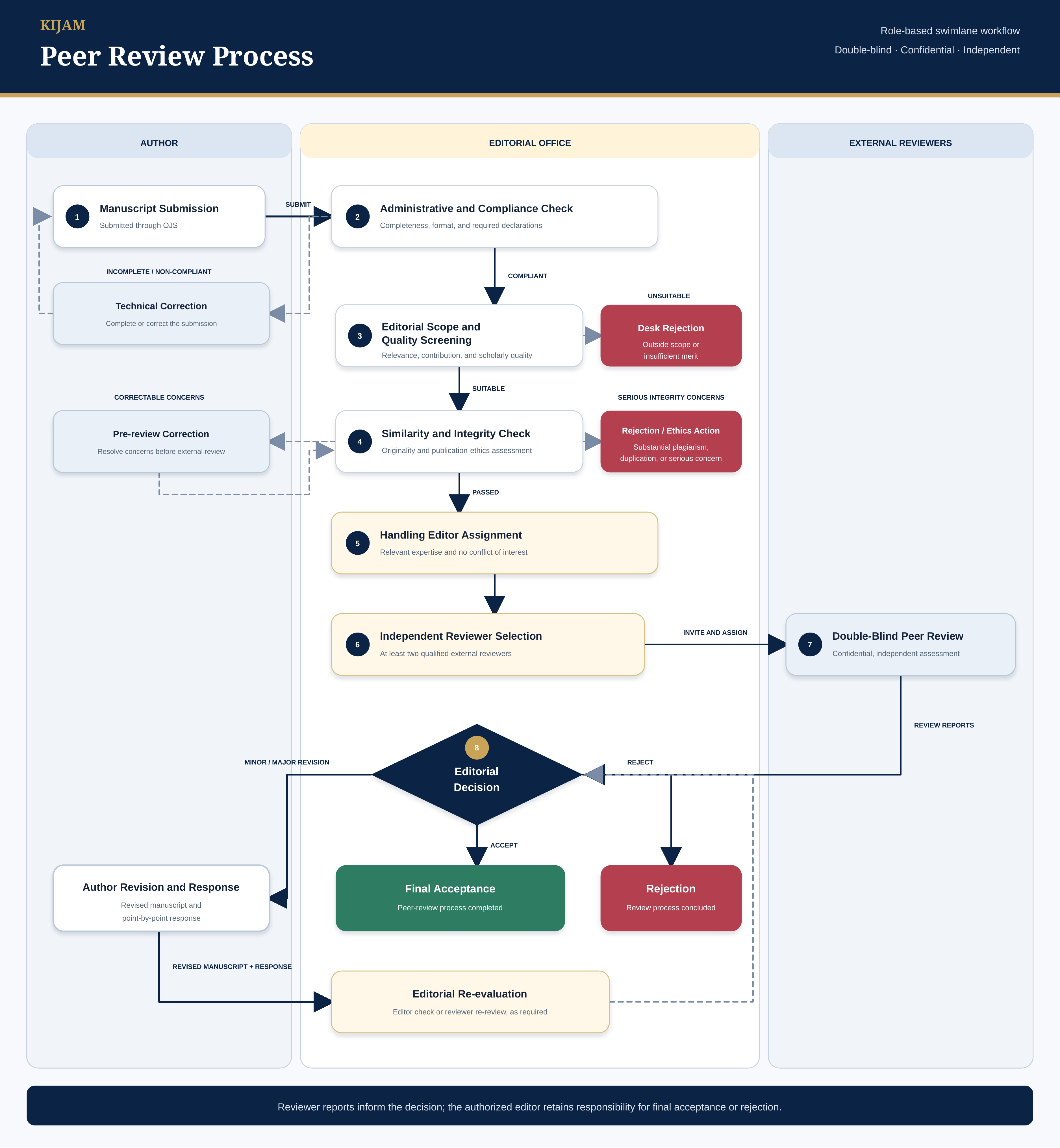
Kalamantra International Journal of Accounting and Management (KIJAM) applies a double-blind, or double-anonymized, peer-review system to all research manuscripts considered for publication. Under this system, the reviewers do not receive information that identifies the authors, while the authors are not informed of the reviewers’ identities. The separation of identities is intended to reduce personal, institutional, and professional bias during the scholarly assessment. The process involves three principal parties: the author, the editorial office, and independent external reviewers. Each party performs a different function. Authors are responsible for the accuracy, originality, and completeness of their submissions. The editorial office manages administrative checks, ethical screening, reviewer selection, and editorial decisions. External reviewers provide independent scholarly assessments within their areas of expertise. Reviewer recommendations provide expert advice but do not determine the publication outcome automatically. The handling editor evaluates the manuscript, the reviewer reports, and the authors’ responses. The Editor-in-Chief or another editor formally authorized by the journal retains responsibility for the final acceptance or rejection of every manuscript.
1. Manuscript Submission
Authors must submit their manuscripts through the KIJAM Open Journal Systems (OJS) platform. Submissions sent outside the journal’s official system are not treated as formal submissions unless the editorial office has provided specific instructions. The submitting author must complete the article metadata and upload all required files. These normally include the anonymized manuscript, author information, affiliations, corresponding-author details, tables, figures, supplementary materials, and any declarations required under the journal’s policies. Because KIJAM uses double-blind peer review, information that directly identifies the authors should not appear in the manuscript file prepared for reviewers. Author names, affiliations, acknowledgements, and other identifying information must be entered or uploaded separately according to the journal’s submission instructions. By completing the submission, the author confirms that the manuscript is original, has not been published previously, is not simultaneously under consideration by another journal, and has been approved by all listed authors. Submission through OJS does not mean that the manuscript has been accepted for peer review or publication. Every manuscript must first complete the journal’s preliminary assessment.
2. Administrative and Compliance Check
After submission, the editorial office examines the manuscript for administrative completeness and compliance with KIJAM’s submission requirements. This examination takes place before the academic quality of the manuscript is evaluated. The editorial team checks whether the required files have been provided, the article metadata are complete, the manuscript follows the journal template, and the necessary sections are present. The team may also verify author information, affiliations, tables, figures, references, supplementary materials, and statements concerning authorship, funding, conflicts of interest, research ethics, and other relevant declarations. The manuscript file is also checked to ensure that identifying information has been removed for double-blind review. A submission that reveals the authors’ identities in the review file may be returned for anonymization before further assessment. If the submission is complete and meets the journal’s technical requirements, it proceeds to editorial screening. If required information is missing or the manuscript does not follow the prescribed format, the submission is returned to the author for Technical Correction. A request for Technical Correction is not an academic rejection. It means that the editorial office cannot continue processing the manuscript until the submission has been corrected or completed. The author must address the specified issues and resubmit the corrected files through OJS. The revised submission is then checked again before it can proceed.
3. Editorial Scope and Quality Screening
A manuscript that passes the administrative check undergoes an initial editorial assessment. The Editor-in-Chief or an assigned editor reads the manuscript to determine whether it is appropriate for KIJAM and sufficiently developed to justify external peer review. The editor first considers whether the subject falls within KIJAM’s focus and scope in accounting and management. The assessment then considers the relevance of the research problem, the clarity of the objectives, the originality of the work, the potential scholarly or practical contribution, the adequacy of the theoretical foundation, and the basic soundness of the research design, analysis, and conclusions. This screening is not intended to replace external peer review. Its purpose is to identify submissions that clearly fall outside the journal’s remit or do not yet meet the minimum scholarly standard required for external evaluation. A manuscript that is relevant and demonstrates sufficient scholarly merit proceeds to the Similarity and Integrity Check. A manuscript may receive a Desk Rejection when it is outside the journal’s scope, lacks a clear contribution, contains fundamental academic weaknesses, or is not sufficiently prepared for peer review. Desk rejection allows the journal to provide an early decision without unnecessarily involving external reviewers. A desk-rejected manuscript does not continue to the independent peer-review stage.
4. Similarity and Integrity Check
Manuscripts that pass the initial editorial screening undergo an originality and publication-integrity assessment. The editorial team examines the manuscript using similarity-detection software and reviews the resulting report in accordance with KIJAM’s plagiarism and publication-ethics policies. The similarity percentage is not interpreted mechanically. The editor considers the location, nature, and extent of the matching material. Properly cited references, standard methodological expressions, and unavoidable technical terminology are distinguished from inappropriate copying, unattributed paraphrasing, redundant publication, or substantial duplication. Where the identified concerns can reasonably be corrected, the manuscript is returned to the author for Pre-review Correction. The editorial office explains the matters that must be addressed before the manuscript can be sent to external reviewers. Once the author submits the corrected version, the manuscript undergoes another similarity and integrity assessment. More serious findings are handled differently. A submission may be rejected or referred for further ethical action when it contains substantial plagiarism, substantial duplication, fabricated or manipulated material, misleading authorship information, or another serious breach of publication integrity. Any such action is handled under KIJAM’s publication-ethics policy. Only manuscripts that satisfy the journal’s originality and integrity requirements proceed to editor assignment and independent peer review.
5. Handling Editor Assignment
A manuscript that passes the preliminary assessment is assigned to a handling editor with expertise relevant to the subject or methodology of the study. The handling editor manages the manuscript during the peer-review process. Before accepting the assignment, the editor must consider whether any personal, professional, institutional, or financial relationship could interfere with an impartial assessment. When a potential conflict of interest exists, the manuscript should be transferred to another qualified editor. The handling editor reviews the manuscript, selects suitable external reviewers, monitors the progress of the review, evaluates the reports received, considers the authors’ revisions, and prepares or records the editorial decision according to the journal’s editorial authority structure. The handling editor must protect the confidentiality of the manuscript and must not use unpublished information contained in the submission for personal, professional, or research advantage.
6. Independent Reviewer Selection
The handling editor appoints at least two qualified external reviewers whose expertise corresponds to the manuscript’s subject matter, theoretical approach, or research methodology. Reviewer selection is based on scholarly competence and independence. The journal seeks reviewers who can evaluate the work objectively and who do not have relationships that could create an actual or perceived conflict of interest. Reviewers should not accept an invitation when they lack the necessary expertise, cannot complete the review responsibly, or have a relationship with the authors or the research that could compromise impartiality. Invited reviewers receive the anonymized manuscript and the journal’s review instructions. They must treat the manuscript and all associated information as confidential. The materials may not be shared with another person, used for personal benefit, or discussed outside the authorized editorial process. If an invited reviewer declines or does not respond, the editor appoints another qualified reviewer. The manuscript proceeds to editorial decision only after the journal has obtained sufficient independent scholarly assessments.
7. Double-Blind Peer Review
The selected reviewers examine the manuscript independently under the double-blind system. Their task is to assess the scholarly strength of the work and provide constructive recommendations that can assist both the editor and the author. Reviewers consider whether the manuscript addresses a relevant issue, presents a clear research objective, uses an appropriate theoretical or conceptual foundation, and applies a suitable research method. They also evaluate the accuracy and transparency of the analysis, the relationship between the findings and conclusions, the adequacy of the references, and the contribution of the work to accounting or management scholarship and practice. Review comments should be specific, reasoned, and respectful. Reviewers should distinguish between essential revisions that affect the validity or contribution of the manuscript and optional suggestions intended to improve its presentation. Personal criticism, unsupported accusations, and requests that do not contribute to the quality of the manuscript are not appropriate. Each reviewer submits comments for the author and a confidential recommendation for the editor. The recommendation is advisory. Reviewers do not communicate acceptance or rejection decisions directly to the author.
8. Editorial Decision
After the required review reports have been received, the handling editor assesses the manuscript together with the reviewers’ evaluations. The editor considers the strength of the reviewers’ reasoning, the seriousness of the concerns raised, and the extent to which the manuscript can be improved through revision. The editor is not required to follow a reviewer recommendation automatically. When reports differ substantially, the editor may assess the arguments independently, request clarification, consult another editor, or obtain an additional expert assessment before reaching a decision. The available editorial decisions are as follows. Accept: An acceptance decision indicates that the manuscript has satisfactorily completed peer review and does not require further substantive academic revision. The manuscript proceeds to Final Acceptance and the production workflow. Minor Revision: A Minor Revision decision is issued when the manuscript is fundamentally sound but requires limited clarification, correction, or improvement. The required changes do not substantially alter the research design, principal analysis, or central conclusions. A minor revision is normally re-evaluated by the handling editor. The editor may consult the reviewers again if the corrections involve matters that require specialist verification. Major Revision: A Major Revision decision is issued when substantial improvements are required before the manuscript can be considered for publication. These revisions may concern the theoretical argument, research method, analysis, interpretation, discussion, presentation of evidence, or relationship between the findings and conclusions. A major revision is not a provisional acceptance. The revised manuscript may be returned to the original reviewers or assigned to other qualified reviewers for another round of evaluation. Reject: A rejection decision is issued when the manuscript does not meet KIJAM’s publication requirements, contains fundamental problems that cannot reasonably be resolved through revision, or fails to provide a sufficient scholarly contribution. Rejection concludes the peer-review process for that submission. The manuscript does not proceed to production.
9. Author Revision and Point-by-Point Response
Authors invited to revise must submit a revised manuscript together with a detailed point-by-point response to the editor and reviewers. The response document should reproduce or clearly identify each comment, explain how it has been addressed, and indicate where the corresponding change can be found in the revised manuscript. Changes should be marked or highlighted in accordance with the instructions contained in the decision letter. When the author does not agree with a recommendation, the comment should not simply be ignored. The author must provide a clear, respectful, and academically supported explanation. The editor will determine whether the explanation is sufficient. Submitting a revised manuscript does not guarantee acceptance. The revision remains subject to editorial re-evaluation and, when necessary, another round of external review.
10. Editorial Re-evaluation
The handling editor compares the revised manuscript with the decision letter, reviewer comments, and point-by-point response. For a Minor Revision, the editor normally determines whether all requested corrections have been completed satisfactorily. For a Major Revision, the manuscript may be returned to the reviewers so that substantive changes can be examined by specialists. If important concerns remain unresolved, the editor may request another revision or reject the manuscript. If the revisions have satisfactorily addressed the academic, ethical, and editorial requirements, the editor may recommend or issue Final Acceptance.
11. Final Acceptance and Rejection
Final Acceptance is granted only after the editor is satisfied that the manuscript meets KIJAM’s scholarly, ethical, and editorial standards. At this point, the peer-review process is complete and the manuscript may enter production. Acceptance applies to the approved version of the manuscript. Any later substantive change must receive editorial approval and may require further assessment. When the required revisions have not been addressed adequately or the manuscript no longer meets the conditions for publication, the editor may issue a rejection. Reviewer reports inform the decision, but the Editor-in-Chief or an authorized editor retains responsibility for the final acceptance or rejection of every manuscript.