Publication Process
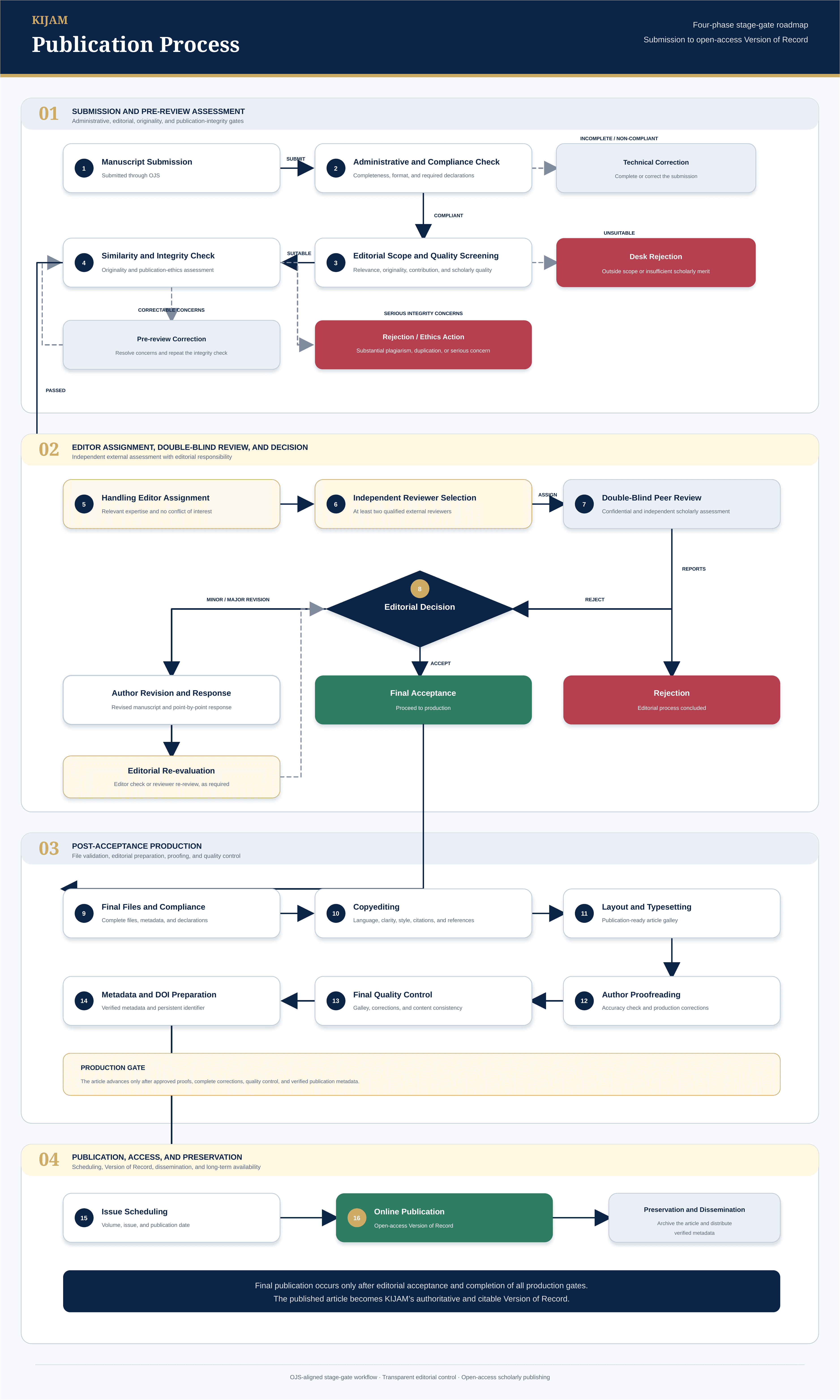
The KIJAM publication process is organized as a four-phase stage-gate workflow. A manuscript advances only after completing the requirements of the preceding phase. The four phases cover submission and preliminary assessment, independent peer review and editorial decision, post-acceptance production, and final publication with continued access and preservation. A manuscript is not considered publishable merely because it has been submitted, reviewed, or revised. It must receive Final Acceptance and complete all technical, editorial, metadata, and production checks before it can be released as the official Version of Record.
Phase 1: Submission and Pre-Review Assessment
The first phase begins with submission through OJS. The editorial office verifies the completeness of the files, metadata, formatting, anonymization, and required declarations. Incomplete or non-compliant submissions are returned for Technical Correction and do not proceed until the identified deficiencies have been resolved. A compliant submission undergoes Editorial Scope and Quality Screening. The editor considers whether the manuscript is relevant to KIJAM and has sufficient originality, contribution, and scholarly quality. Unsuitable manuscripts may receive Desk Rejection without external review. A manuscript that passes editorial screening undergoes the Similarity and Integrity Check. Correctable issues are returned for Pre-review Correction and examined again after revision. Substantial plagiarism, duplication, or another serious integrity concern may result in rejection or further action under the journal’s publication-ethics policy. Only manuscripts that pass all four preliminary gates proceed to handling editor assignment and independent peer review.
Phase 2: Editor Assignment, Double-Blind Review, and Decision
The accepted pre-review submission is assigned to a handling editor who has relevant expertise and no disqualifying conflict of interest. The handling editor selects at least two qualified external reviewers and manages the double-blind review. The reviewers independently assess the manuscript and submit confidential reports. After sufficient reports have been received, the handling editor evaluates the manuscript and the reviewers’ advice before issuing a decision of Accept, Minor Revision, Major Revision, or Reject. Authors invited to revise must submit a corrected manuscript and a point-by-point response. The handling editor examines the revision and may return it to the reviewers when specialist re-evaluation is required. A rejected manuscript leaves the publication workflow. A manuscript that has satisfactorily completed peer review receives Final Acceptance and enters the production phase.
Phase 3: Post-Acceptance Production
Final Files and Compliance
After Final Acceptance, the editorial office prepares the accepted submission for production. The final manuscript file must correspond to the version approved by the editor. The production team verifies the final title, author names, affiliations, corresponding-author details, abstract, keywords, tables, figures, captions, supplementary materials, acknowledgements, funding information, conflict-of-interest statement, and other required declarations. The identity and order of the authors must be consistent with the approved submission. Any proposed authorship change requires an explanation and must be handled according to the journal’s authorship policy. Outstanding documentation or unusable production files are returned for correction. The manuscript does not proceed to copyediting until the final files and associated information are complete.
Copyediting
The accepted manuscript is copyedited for language, clarity, consistency, journal style, citations, and references. The copyeditor may correct grammar, punctuation, spelling, formatting, terminology, and inconsistencies that affect readability. Copyediting does not authorize the journal to alter the authors’ results, interpretation, or conclusions. Questions involving meaning, technical accuracy, or potentially substantive changes are referred to the author or editor for clarification. References are checked for consistency with the journal’s required style. Citations and reference entries should correspond, and information such as author names, publication years, titles, journal details, and DOI links should be presented as accurately as possible. Once the copyediting queries have been resolved, the manuscript proceeds to layout and typesetting.
Layout and Typesetting
The copyedited manuscript is converted into KIJAM’s official publication format. Text, headings, tables, figures, captions, equations, references, author information, and publication details are arranged as a publication-ready article galley. The layout team checks the visual consistency of the article and ensures that tables, figures, and other elements are placed and reproduced appropriately. The resulting galley represents the intended appearance of the published article but is not yet the Version of Record. The galley must still undergo Author Proofreading and Final Quality Control.
Author Proofreading
The corresponding author receives the proof version for final examination. The author must compare the proof with the accepted manuscript and check the accuracy of the text, author information, affiliations, tables, figures, captions, equations, references, and other production elements. The author must also answer all queries raised by the copyeditor or production team. Corrections should be returned within the period specified by the journal to prevent unnecessary publication delays. Proofreading is intended to correct typographical, formatting, and production errors. It is not an opportunity to rewrite the article, add new data, change the analysis, or alter the conclusions. A substantive correction is considered only when it is necessary to resolve a material error and has been approved by the editor.
Final Quality Control
After the author’s corrections have been incorporated, the editorial or production team performs a final quality-control examination. The team verifies that the approved corrections have been applied, production queries have been resolved, tables and figures are complete, references are consistently presented, and the article contains no obvious formatting or production error. The final galley is also compared with the article metadata to ensure that the title, author names, affiliations, abstract, and other bibliographic information are consistent. An article that does not pass this quality-control gate is returned to the appropriate production stage for correction.
Metadata and DOI Preparation
Once the final galley is approved, the article metadata are prepared and verified. Accurate metadata are essential because they are used by OJS, DOI registration services, search engines, indexing databases, library catalogues, and citation-management systems. The metadata include the article title, author names, ORCID identifiers where available, affiliations, abstract, keywords, references, volume and issue information, publication date, licence information, and other identifiers. The DOI is prepared or registered according to the publisher’s DOI-registration procedure and linked to the article’s final landing page. The DOI and metadata must refer to the correct Version of Record. Errors in author names, article titles, or identifiers can affect discoverability and citation. For that reason, metadata verification is treated as a formal publication gate rather than a purely administrative formality.
Phase 4: Publication, Access, and Preservation
Issue Scheduling
An article that has completed production is assigned to an appropriate volume and issue according to KIJAM’s publication schedule. The editorial office confirms the sequence of articles, issue information, page or article numbering where applicable, and the official publication date. Scheduling is completed only after the galley, metadata, and DOI information are ready. Placement in a scheduled issue does not permit further substantive changes. Any correction required after this point must be handled by the editor and production team before publication.
Online Publication
After scheduling and final approval, the article is published online as KIJAM’s official Version of Record. This is the final, authoritative, and citable version maintained by the journal. The Version of Record contains the approved article, complete bibliographic information, DOI, licence statement, and other publication details. It is made freely available under KIJAM’s open-access policy. Publication is not conditional upon payment by the author. In accordance with KIJAM’s Article Processing Charges policy, authors are not required to pay submission, review, processing, or publication fees.
Preservation and Metadata Dissemination
Following online publication, the article remains part of the permanent scholarly record. The published file and its metadata are preserved according to KIJAM’s Archive Policy. Verified metadata may be distributed to DOI registration services, indexing databases, search engines, library systems, and other scholarly discovery platforms. Dissemination allows the article to be identified, cited, and accessed beyond the journal website. Any correction, update, retraction, or other change made after publication must be handled transparently under the journal’s post-publication and publication-ethics policies. The original publication record must not be altered without an appropriate editorial record. Final publication occurs only after editorial acceptance and the successful completion of file validation, copyediting, layout and typesetting, author proofreading, final quality control, metadata and DOI preparation, issue scheduling, and final publication approval.