
Peer Review Process
Sandhana International Journal of Multidisciplinary Studies (SIJMS) applies a double-blind peer-review process, in which the identities of the authors and reviewers are concealed from one another. Every manuscript that proceeds to peer review is evaluated by at least two independent reviewers. Because SIJMS publishes multidisciplinary research, the assessment may be conducted in parallel to ensure that the manuscript’s principal discipline, research methodology, and integration of different fields are evaluated appropriately.
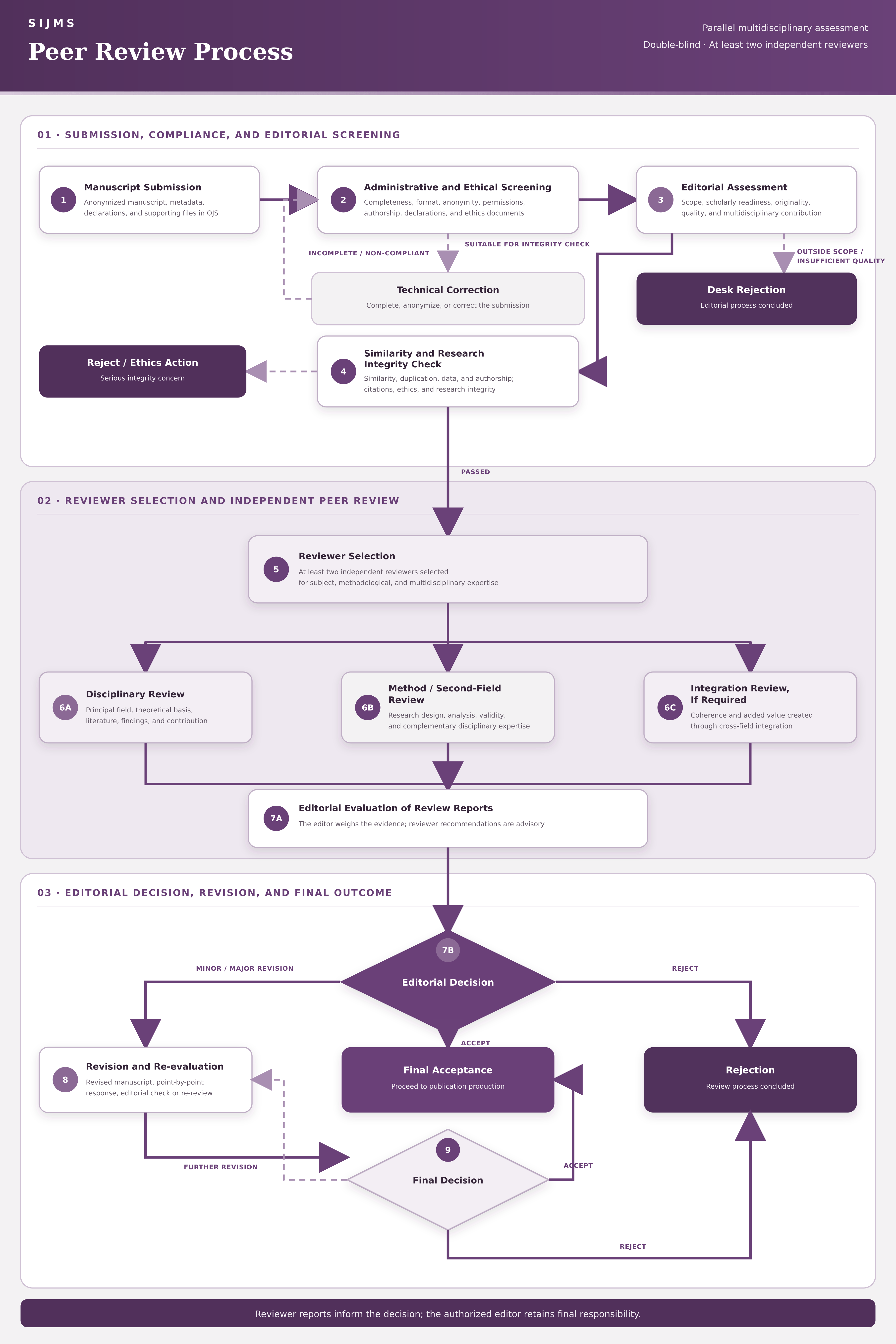
1. Submission, Compliance, and Editorial Screening
1. Manuscript Submission
The review process begins when the author submits an anonymized manuscript through the journal’s Online Journal System (OJS). The submission must include complete manuscript metadata, the required declarations, and all supporting files. Information that could reveal the authors’ identities must be removed from the manuscript to maintain the double-blind review process.
2. Administrative and Ethical Screening
The editorial team examines the submission for administrative completeness and compliance with the journal’s requirements. This screening covers the manuscript format, author anonymity, permissions, authorship information, required declarations, and relevant ethical documents. If the submission is incomplete or does not comply with the journal’s requirements, it is returned for technical correction. The submission must be completed, anonymized, or corrected as necessary before it can return to the screening process.
3. Editorial Assessment
After passing the administrative and ethical screening, the manuscript undergoes an editorial assessment. At this stage, the editor evaluates its conformity with the journal’s scope, scholarly readiness, originality, overall quality, and contribution to multidisciplinary studies. A manuscript that falls outside the journal’s scope or does not demonstrate sufficient scholarly quality may receive a desk rejection, after which the editorial process is concluded. A manuscript considered suitable proceeds to the similarity and research integrity check.
4. Similarity and Research Integrity Check
The manuscript is examined for similarity, duplication, data-related concerns, authorship issues, citation practices, ethical compliance, and overall research integrity. This stage is intended to identify problems that may affect the reliability or ethical acceptability of the submitted work. If a serious research-integrity concern is identified, the manuscript may be rejected or referred for an appropriate ethics action. A manuscript that passes this assessment proceeds to reviewer selection.
2. Reviewer Selection and Independent Peer Review
5. Reviewer Selection
The editor appoints at least two independent reviewers based on their subject knowledge, methodological competence, and relevant multidisciplinary expertise. Reviewer selection is intended to ensure that every important aspect of the manuscript is assessed by individuals with suitable academic or professional competence.
6A. Disciplinary Review
The disciplinary reviewer evaluates the manuscript from the perspective of its principal field. The assessment includes the theoretical foundation, relevant literature, research findings, and the manuscript’s contribution to the discipline.
6B. Method or Second-Field Review
The method or second-field reviewer evaluates the research design, analytical procedures, validity of the study, and any complementary disciplinary expertise required by the manuscript. This review ensures that the methods and interpretation are appropriate for the questions addressed by the study.
6C. Integration Review, If Required
For manuscripts that combine several disciplines, an additional integration review may be conducted when required. This assessment focuses on the coherence of the interdisciplinary approach and the added value created through the integration of different fields. It determines whether the multidisciplinary elements are meaningfully connected rather than merely presented alongside one another.
7A. Editorial Evaluation of Review Reports
After the reviews have been completed, the editor evaluates all reviewer reports and considers the evidence, comments, and recommendations provided. Reviewer recommendations serve an advisory function and do not independently determine the outcome of the manuscript. Responsibility for the editorial decision remains with the authorized editor.
3. Editorial Decision, Revision, and Final Outcome
7B. Editorial Decision
Based on the manuscript, the reviewer reports, and the editorial evaluation, the editor may issue one of three decisions: minor or major revision, acceptance, or rejection. A manuscript requiring minor or major changes proceeds to revision and re-evaluation. A manuscript considered suitable for publication receives final acceptance and proceeds to publication production. A rejected manuscript leaves the review process, and its evaluation is concluded.
8. Revision and Re-evaluation
When revision is required, the authors must submit a revised manuscript accompanied by a point-by-point response explaining how each editorial and reviewer comment has been addressed. The revised submission is then examined through an editorial check or returned to the reviewers for re-review, depending on the nature and extent of the required changes.
9. Final Decision
Following re-evaluation, the editor makes a final decision. The revised manuscript may be accepted, rejected, or returned to the authors for further revision. If accepted, the manuscript receives final acceptance and proceeds to publication production. If rejected, the peer-review process is concluded. When further revision is required, the manuscript returns to the revision and re-evaluation stage before another final decision is made. Throughout the process, reviewer reports inform the editorial decision, while the authorized editor retains final responsibility for determining whether the manuscript is accepted or rejected.