Publication Process
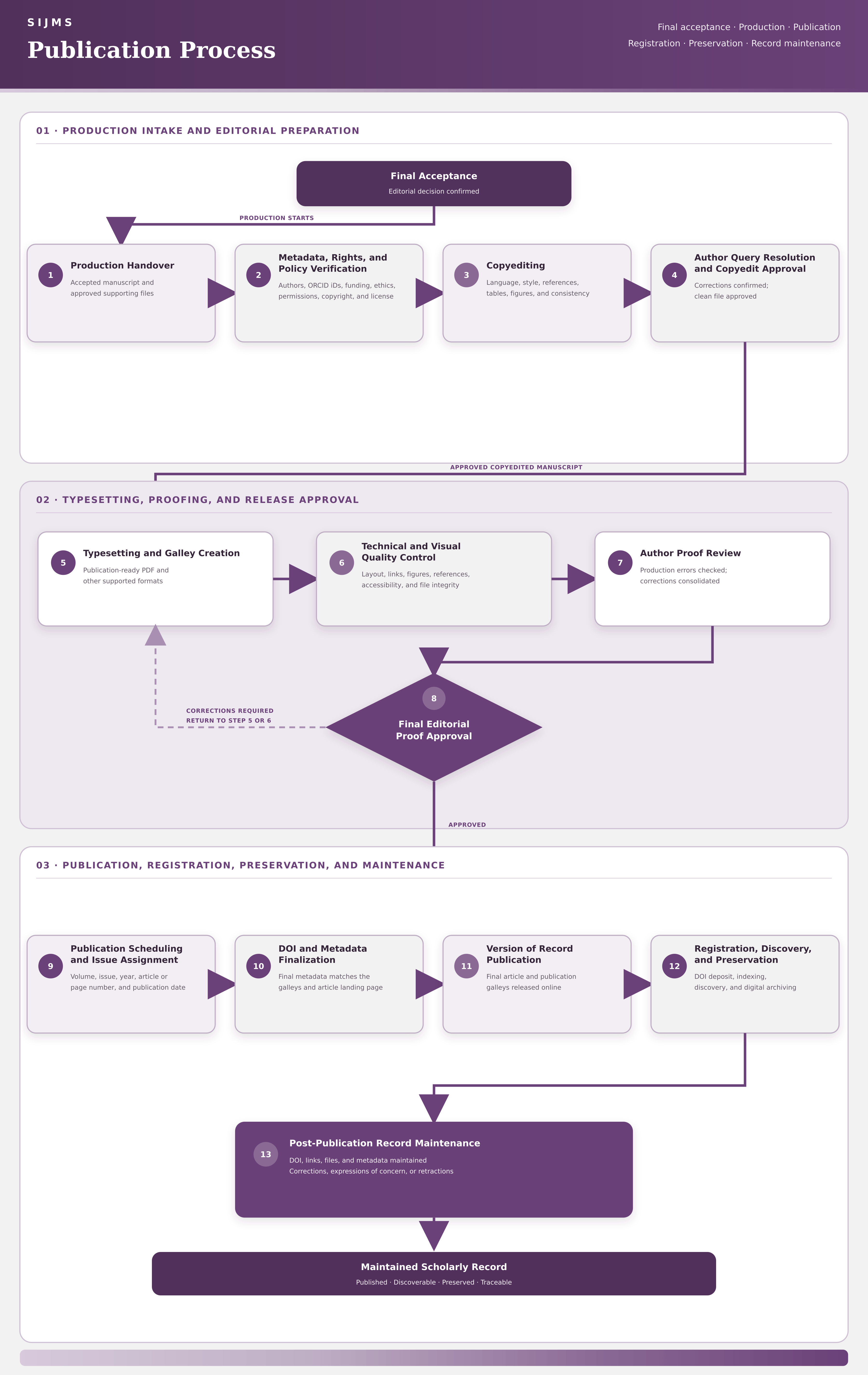
The publication process of Sandhana International Journal of Multidisciplinary Studies (SIJMS) begins after a manuscript has completed the peer-review process and received Final Acceptance from the authorized editor. Final acceptance confirms that the manuscript has satisfied the journal’s scientific and editorial requirements and may proceed to production. The process is organized into three main phases: production preparation, typesetting and proof approval, and final publication and record maintenance.
1. Production Intake and Editorial Preparation
1. Production Handover
Following final acceptance, the accepted manuscript and all approved supporting files are transferred to the production stage. Only the version authorized by the editor is used for further processing. Earlier drafts or unapproved files are excluded to prevent inconsistencies during production.
2. Metadata, Rights, and Policy Verification
The editorial team verifies that the article metadata and publication information are complete and consistent. This includes the article title, author names and order, affiliations, ORCID iDs, funding information, ethical declarations, permissions for third-party materials, copyright ownership, and the applicable publication license. Any discrepancy must be resolved before the manuscript proceeds to copyediting. This verification ensures that the information displayed in the article, PDF file, journal website, and DOI record will be consistent.
3. Copyediting
The accepted manuscript undergoes copyediting to improve its language, readability, presentation, and conformity with the SIJMS editorial style. The copyeditor checks grammar, spelling, terminology, headings, citations, references, tables, figures, and internal consistency. Copyediting must not alter the scientific meaning, findings, arguments, or conclusions of the article without the authors’ knowledge and editorial approval. Questions concerning unclear statements, missing information, or inconsistencies are recorded as author queries.
4. Author Query Resolution and Copyedit Approval
The corresponding author receives the copyedited manuscript and responds to all editorial queries. The author confirms factual information, addresses identified inconsistencies, and verifies corrections that may affect the meaning or presentation of the article. After all queries have been resolved, the clean copyedited manuscript is approved for typesetting. This approved file becomes the official source used to prepare the publication galleys.
2. Typesetting, Proofing, and Release Approval
5. Typesetting and Galley Creation
The approved copyedited manuscript is converted into a publication-ready PDF and any other formats supported by the journal. During typesetting, the article is arranged according to the SIJMS template, including its headings, paragraphs, tables, figures, references, author information, citation details, copyright statement, and license information. The resulting files are referred to as publication galleys. These files must accurately represent the approved content and maintain a consistent appearance across the journal.
6. Technical and Visual Quality Control
The production team conducts a technical and visual examination of the galleys. This examination covers page layout, fonts, headings, equations, tables, figures, hyperlinks, citations, references, accessibility, supplementary files, and general file integrity. The team also checks that no text, figure, table, or symbol has been omitted, distorted, misplaced, or incorrectly converted during typesetting. If a production defect is identified, the file is returned to the typesetting stage for correction.
7. Author Proof Review
The corresponding author receives the proof for final examination. At this stage, the author checks the spelling of author names, affiliations, article content, tables, figures, references, and other elements that may have been affected during production. The proof stage is intended primarily to correct typesetting and production errors. Substantial additions, changes to the research findings, modifications to authorship, or other major revisions are not normally permitted unless they have been explicitly approved by the editor. All proof corrections should be submitted in one consolidated response.
8. Final Editorial Proof Approval
After the author’s corrections have been incorporated, the editor examines the revised proof and confirms whether all approved corrections have been properly applied. If additional corrections are required, the article returns to Typesetting and Galley Creation or Technical and Visual Quality Control, depending on the nature of the problem. The corrected file is reviewed again before approval. When the editor confirms that the galleys are complete and accurate, the article proceeds to publication scheduling.
3. Publication, Registration, Preservation, and Maintenance
9. Publication Scheduling and Issue Assignment
The approved article is assigned to a scheduled journal issue. The editorial team determines the appropriate volume, issue, publication year, article number or page range, and official publication date in accordance with the publishing schedule of SIJMS. The assigned information must be consistent across the article landing page, publication galleys, table of contents, citation information, and external metadata records.
10. DOI and Metadata Finalization
Before publication, the DOI and article metadata are checked against the final galleys and article landing page. The verification covers the article title, author names, ORCID iDs, affiliations, abstract, keywords, funding information, references, license, publication dates, and article URL. This stage ensures that the metadata submitted to Crossref accurately represents the published article. The DOI must direct readers to a unique and active landing page containing the article’s bibliographic information and access to its publication files.
11. Version of Record Publication
Following final approval, the article landing page and final publication galleys are released online. This published article constitutes the Version of Record, namely the definitive and citable version formally issued by SIJMS. The published record contains the DOI, citation information, author and affiliation details, copyright and license statements, and relevant editorial dates. The published files must correspond exactly with the version approved during the final proof stage.
12. Registration, Discovery, and Preservation
After publication, the article DOI is registered and its metadata and references are deposited with Crossref. The article information is also distributed or submitted to relevant indexing and discovery services in accordance with the journal’s arrangements. The published content is included in the journal’s digital archiving system to support long-term preservation and continued access. If a DOI deposit fails or incorrect metadata is identified, the record must be corrected and resubmitted.
13. Post-Publication Record Maintenance
The journal continues to maintain the article after publication. This responsibility includes monitoring DOI resolution, article links, publication files, and metadata to ensure that the scholarly record remains accurate, accessible, and traceable. When a significant error or publication-ethics concern is reported, the editor evaluates the matter in accordance with the journal’s policies. Depending on the findings, SIJMS may publish a correction, an expression of concern, or a retraction. Any change to the published record must be transparently documented, linked to the original article, and reflected in the relevant DOI and indexing metadata. The publication process concludes with a scholarly record that is published, discoverable, preserved, and continuously maintained.